If you're planning to work in the United States on an H1B visa, one of the most important questions you'll ask is, 'How long does an H1B visa last?'
The answer determines how long you can live and work in the U.S., whether you need extensions, and when you should start planning for long-term immigration options such as a green card.
Many professionals also ask related questions:
- How long do H1B visas last in total?
- What is the duration of an H1B status?
- What happens after the maximum stay period?
- And how long are H1B visas good for after approval?
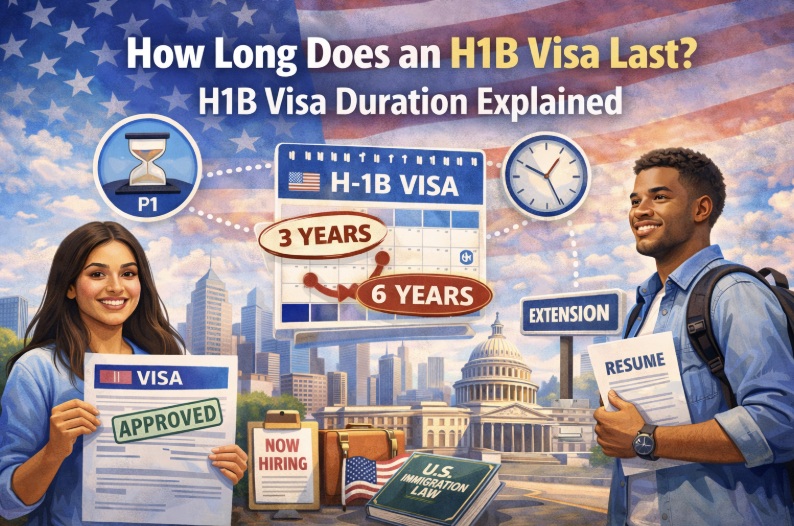
In most cases, the H1B validity period begins with an initial three-year term and can extend up to a maximum of six years in the United States.
However, several factors—such as employer petitions, immigration status changes, and green card applications—can influence the total H1B visa duration.
In this comprehensive guide, you'll learn:
- The official duration of H1B status
- How the H1B visa timeline works
- Extension options beyond six years
- Factors that affect how long H1B visas last
What Is an H1B Visa?
The H1B visa is a temporary work visa that allows U.S. companies to employ foreign professionals in specialized occupations such as technology, engineering, finance, and healthcare.
The program allows skilled international workers to contribute their expertise to the U.S. economy.
When professionals research immigration options, one of the first things they want to know is the H1B visa duration and how long they can stay in the country.
Purpose of the H1B Visa
The H1B visa was created to help American employers fill highly skilled roles that require specialized knowledge.
These positions fall under the category of specialty occupation jobs.
Examples include:
- Software engineers
- Data scientists
- Mechanical engineers
- Financial analysts
- Medical researchers
These jobs typically require at least a bachelor's degree or equivalent experience.
Source: Wikipedia - H-1B visa
Industries That Commonly Use H1B Visas
Several industries rely heavily on international professionals.
| Industry | Typical H1B Jobs |
|---|---|
| Technology | Software developer, AI engineer |
| Finance | Financial analyst, quantitative researcher |
| Healthcare | Medical researcher, healthcare analyst |
| Engineering | Civil, mechanical, and electrical engineer |
| Consulting | Management consultant |
Technology companies account for the majority of H1B petitions each year.
Role of Employers in Sponsoring H1B Workers
Unlike some immigration programs, the H1B visa requires employer sponsorship.
Employers must:
- File Form I-129 with U.S. immigration authorities
- Prove the position qualifies as a specialty occupation
- Pay government filing fees
- Demonstrate that hiring a foreign worker will not harm U.S. workers
Because of these requirements, the duration of H1B status is closely tied to the employer's petition.
Temporary vs Permanent Immigration
The H1B visa is considered a temporary non-immigrant visa.
However, it allows something unique in U.S. immigration law known as dual intent.
This means workers can work temporarily in the U.S. and apply for permanent residency at the same time.
Understanding how long an H1B visa lasts helps workers decide when to begin the green card process.
How Long Does an H1B Visa Last?
The short answer to how long an H1B visa lasts is that the visa typically begins with a three-year approval period and can be extended for a total of six years.
This timeline represents the standard H-1B validity period.
Standard H1B Visa Duration
| Stage | Duration |
|---|---|
| Initial approval | 3 years |
| First extension | An additional 3 years |
| Total maximum stay | 6 years |
This means the total H1B visa duration for most workers is six years.
Source: USCIS - H-1B Specialty Occupations
How Long Are H1B Visas Good For?
If you're wondering how long H1B visas are good for, the answer depends on several factors: employer petition length, employment contract duration, and immigration approvals. However, most petitions follow the standard 3 + 3 year structure.
When Workers Must Extend Their Visa
Many workers begin their extension process during the third year of employment.
The employer must file a new petition using Form I-129 before the first approval expires.
If approved, workers receive an additional three years of H1B status.
Simple Explanation of H1B Visa Duration
To summarize: Initial approval: 3 years. Extension: 3 years. Maximum stay: 6 years.
This is the standard duration of H1B status for most foreign professionals working in the United States.
H1B Visa Initial Duration (First Approval Period)
When a worker first receives an H1B visa, the initial approval usually lasts three years. This period is called the initial three-year term.
Why USCIS Grants Three Years
The three-year timeframe allows immigration authorities to monitor: Employer compliance, Worker eligibility, Ongoing job requirements. It also gives companies flexibility when planning long-term projects.
Situations Where Shorter Approvals Occur
Sometimes the H1 visa duration may be shorter than three years. Examples include: Short-term employment contracts, Temporary project work, Employers request shorter petition periods.
For example, if a company hires a worker for a two-year project, the visa may be approved only for that duration.
Employer Petitions and Visa Validity
The length of the employer's petition influences how long H1B visas are good for. Employers define: Job position, Employment duration, Work location. Immigration authorities typically approve the visa based on the employer's requested timeframe.
Employment Authorization Length
During the initial approval period, H1B workers receive full work authorization, legal residency in the United States, and the ability to extend status later.
Maximum H1B Visa Duration (6-Year Limit)
The total maximum stay allowed under H1B status is six years. This is known as the maximum six-year stay.
How Long Do H1B Visas Last in Total?
If you're asking how long H1B visas last, the typical total stay is 6 years—consisting of the first 3 years and a second 3-year extension.
What Happens After Reaching the 6-Year Cap?
After reaching the maximum stay, workers usually must leave the United States and remain outside the country for at least one year. After this period, they may apply for a new H1B visa.
Exceptions to the 6-Year Rule
Some workers qualify for extension beyond six years when pursuing permanent residency. Key immigration steps include: labor certification, approved I-140. Workers with these approvals may qualify for extended H1B status.
Grace Periods After H1B Expiration
If employment ends early, workers may receive a 60-day grace period. During this time, they can: Find a new employer, Transfer their H1B visa, Change immigration status. This grace period helps prevent sudden visa violations.
H1B Visa Extensions: How to Stay Longer
If a worker wants to remain in the U.S. after the first three years, they must apply for an H-1B extension.
Standard Extension Process
The employer files a new petition using Form I-129. The process includes: Employer files extension petition, USCIS reviews the request, Approval grants additional work authorization. This extension typically provides another three years.
Extension Eligibility
Workers must: Maintain valid H1B status, Continue working in a specialty occupation, Remain employed by the sponsoring employer.
Employer Responsibilities
Employers must: Pay filing fees, Submit updated documentation, Confirm employment details. Because the visa is employer-sponsored, workers cannot extend H1B status independently.
Extension Timelines
Many employers begin extension filings 6 months before visa expiration. This ensures workers maintain legal status without interruptions.
Factors That Affect H1B Visa Duration
Although the standard duration of H1B is six years, several factors can affect how long workers remain in the United States.
Employer Petition Validity
The duration of the employer petition determines how long the visa remains valid.
| Employer Contract | Visa Approval |
|---|---|
| 1-year project | 1-year visa |
| 2-year contract | 2-year visa |
| Long-term employment | 3-year visa |
Project Duration
Short-term consulting roles sometimes result in shorter H1B approvals. Consulting firms often file extensions when projects change.
Job Role Changes
If workers change job roles or locations, employers may need to file amended petitions. These changes can affect how long H1B visas are good for.
Employer Transfers
H1B workers can change employers through the H1B transfer process. The new employer must file a new petition. If approved, workers can continue employment without restarting the six-year clock.
Green Card Applications
Some workers extend their H1B beyond six years through AC21 extension rights. These rights allow extensions when labor certification has been filed or the worker has an approved I-140. This helps employees remain in the United States while waiting for green card processing.
Final Thoughts: Understanding H1B Visa Duration
If you're asking how long an H1B visa lasts, the key takeaway is simple. The typical H1B visa duration follows a 3-year initial approval plus a 3-year extension, allowing a maximum six-year stay in the United States.
However, many workers remain longer through green card applications, AC21 extension rights, and approved I-140 petitions.
Understanding how long H1B visas last helps foreign professionals plan their careers, immigration pathways, and long-term opportunities in the United States.
To know more about H1B Visas, feel free to explore Flashfire Jobs Blogs.
FAQs
Q. How long does an H1B visa last?
A. The standard H1B visa lasts three years initially and can be extended for a maximum of six years.
Q. How long do H1B visas last in total?
A. Most workers remain in H1B status for up to six years, though extensions beyond six years may be possible.
Q. What is the maximum duration of H1B status?
A. The maximum stay under H1B status is six years unless the worker qualifies for additional extensions.
Q. Can H1B visas be extended beyond 6 years?
A. Yes. Workers pursuing permanent residency may qualify for extension beyond six years under AC21 extension rights.
Q. How long are H1B visas good for after approval?
A. Initial approvals usually last three years, depending on the employer's petition.
Q. What happens after the H1B visa expires?
A. Workers must either leave the United States, change immigration status, or apply for extensions.
Q. Does the H1B visa duration depend on the employer?
A. Yes. The employer's petition often determines the initial visa validity.
Q. Can H1B visa holders apply for a green card during their visa period?
A. Yes. The H1B visa allows dual intent, meaning workers can apply for permanent residency while working in the United States.